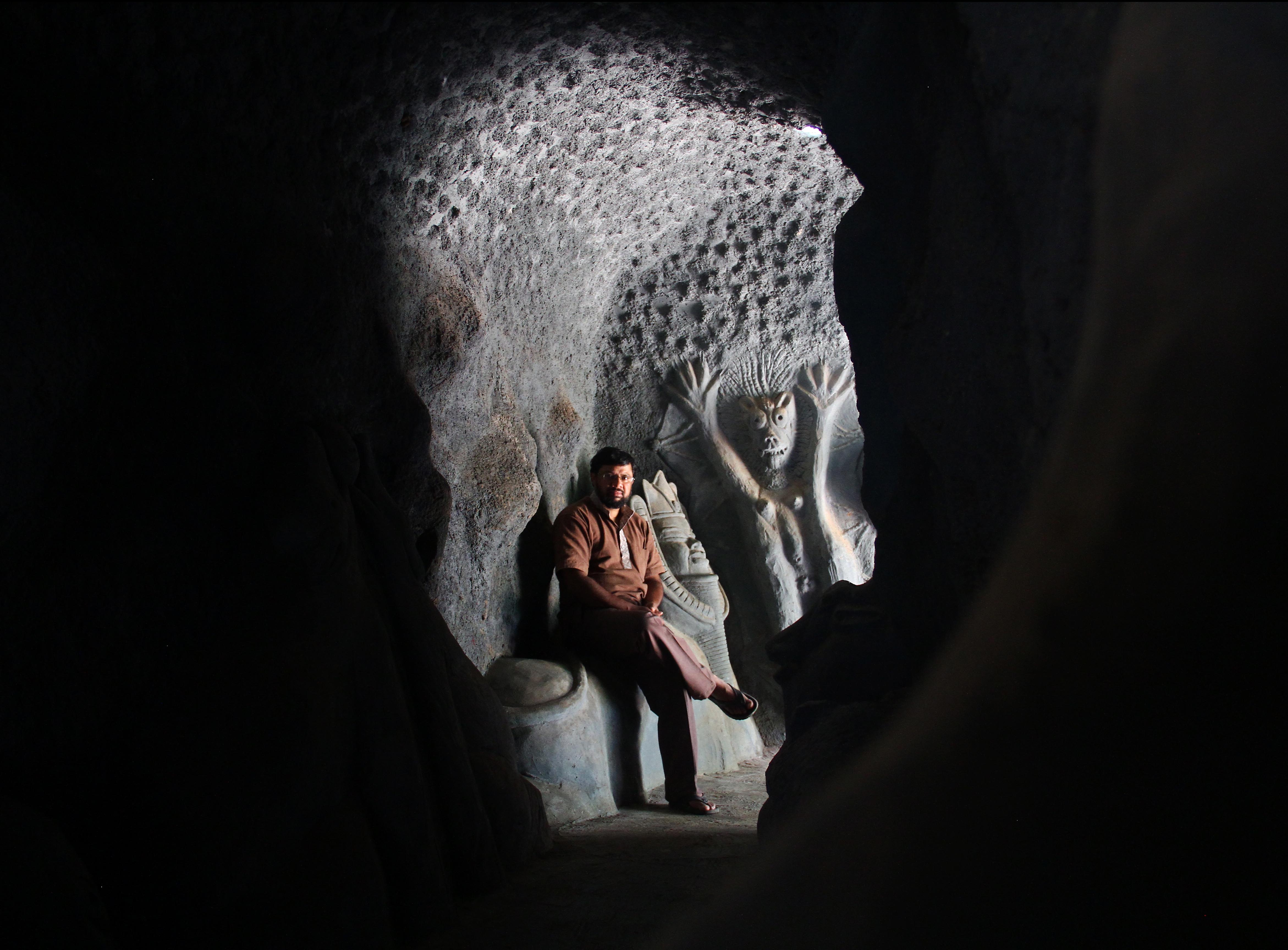
 A life-like structure of a demon’s head is what ushers you to ‘Valmeekam’, the sole terracotta tribal museum in Kerala. Inch a little towards the entrance and you may see a bearded man painting one of the pillars green. But George Kutty is sure to look up from his chore and welcome you with both his hands to the museum where he had invested his heart and soul for the past three years. From the minute detailing of the pillar to the large terracotta sculptures that beckon you from the mysterious labyrinth-like structure, everything in Valmeekam has been conceptualised, designed and built by this exceptional man.
George Kutty had envisioned a museum that would impart ample information about the erstwhile tribal era to the coming generation. However, his sculptures are philosophical and spiritual to the very core and oust out negativity from the viewers. Etching the perennial struggles of tribes with his rustic yet adept handwork, Kutty is in a sole resolve to make people delve deep into their own selves. The sculptures 25 in number represent the vicious life circle of a human being. 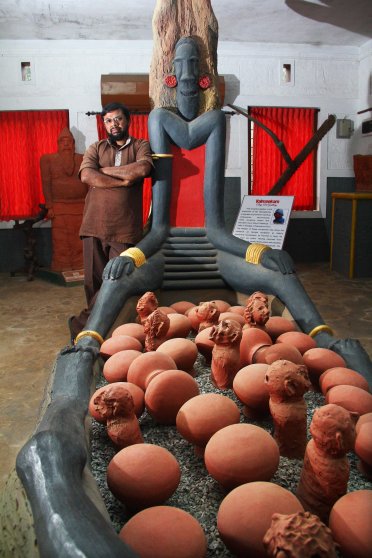
“After years of wandering, I came to my land one fine day and started learning about the indigenous tribes and their culture. With a museum I wanted to showcase my devotion to Mother Earth. So in 2011 I bought this land,” says Kutty.
Located at one of the major tourist centres in Wayanad, Kuruvadweep, Valmeekam is always bustling with visitors. However, George Kutty, who spends most of his day here, makes sure to keep the sanctity of the museum intact. This gifted sculptor recalls the day he set out penniless to build a museum on the shores of River Kabini.
“The museum was always there in the back of my mind but I had no money to go about it. So I have travelled around India, visited places that have a rich history of sculpture art such as Hampi and returned back with a decision. Even though, I kept on making clay sculptures in a studio I set up at my home in Payyampally, it took ten years for me to actually buy a 50 cent land at Kuruvadweep,” says George Kutty. This ardent disciple of Nitya Chaithanya Yati, had to do myriad businesses such as hotel and cold storage to find the initial funding for his brainchild. But he says it all turned out good because of Yati’s blessings and nothing else.
The museum, which often serves as an eye-opener to the onlookers, has given George Kutty many memories to cherish. Even though, there are many occasions when he was taken aback by the response from the people, it was the words of a college student that stayed with him.
“A college student who visited Valmeekam wrote he was about to commit suicide due to many personal issues haunting him but the museum had given him his senses and serenity back. And what more can I ask for,” George Kutty exhales.
He wanted each of his sculptures to have a mystifying aura about them. Hence, the clay walls of the maze have small clefts that hide these alluring terracotta oeuvres. Unless you walk right before them you may not get to see them even. Ask him whether he had seen this maze-like structure anywhere else and Kutty says it is his special penchant for JCBs that made him come up with these walls. But he grows numerous wild plants, butterflies and birds inside the maze making it a small forest.
Grorge Kutty has taken pictures of around ten tribal clans such as Paniya, Kuruma, Kuruchya, Irular, Muzhukurumar, Kattunaikkar, Malayan, Kani, Muthuvan and Malappulayan and recreated them without losing their essence. For Georgekutty availing clay never posed an issue. In Wayanad there are many artisans (kumbharans), who earn their livelihood from pottery making. And George Kutty befriended them and has been getting clay from them for a meager amount.
“I have some more future plans for the museum. I am working on sculptures that would bring back the ancient tribal arts that are no longer to be seen. So they will make an entrance into the museum soon. I also plan to make a studio on the top floor of the museum,” he says.
Entwining man’s perpetual quest for spirituality with emotions such as hunger, passion and love, this sculptor carves sheer poetry on clay. Transcending from mere eye candy to thought provoking art, these works stay true to their roots. There are sculptures that portray tribal camaraderie, reposing hermits, breeding-breastfeeding women, the oneness of man and woman and man’s eternal bond with Mother Earth. He seems to say that love and passion are inimitable for living beings as they are the source of life.
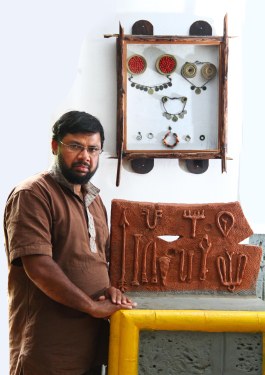
After the trail through the terracotta maze we get to experience a rare collection of tribal ornaments and tools from eons  ago. Among them is a pair of bulky earrings made with circassian seeds (thoda). This chunky circle-shaped jewelry used to leave a large hole on the ear lobes of tribal women. Necklaces made of copper coins and threads (kasumala), beaded bracelets and bangles are displayed in the jewellery session. Clay platelets that remind you of Edakkal Caves are also George Kutty’s creations. Agricultural tools such as ‘kalappa’, ‘njavara’, ‘pulithoni’ and ‘muram’, fishing tools such as ‘choonda’ and meenkooda, all from the personal collections of Kutty are also being exhibited in the museum. Multiple photographs taken from in and around Wayanad are also being exhibited in the museum.
George Kutty’s hands have made the pillars to the enticing sculptures at ‘Valmeekam’ . So it comes as no surprise when he says he cherishes ‘Valmeekam’ like his own sons. He made his family a part of it all too. His mother and wife have a shop in the same building that sells Bamboo artifacts, Wayanadan oils, honey and George Kutty’s very own tribal masks.
Box
 George Kutty’s sculptures belong to four categories ‘Transfiguration of Buddha’, the Chemistry of Nature, Mother and Child and Mother is Nature and Nature is mother.
Transfiguration of Buddha series walks us through the five stages of Buddha’s life – Childhood, teenage, youth, old age and Nirvana. However, unlike the Buddha sculptures you see in Buddhist monasteries across the world George Kutty’s Buddha adapts a Dravidian avatar and starkly resembles Wayanadan tribes. According to George Kutty Buddha was perfect to depict man’s life cycle.
Chemistry of nature is all about the raw passion, sensuality and fierce love. By showing man and woman in an embrace, Kutty says that their union denotes the possibility of a life. He says unless there is love or sex, there is no possibility of hope.
It says that nothing can replace the unconditional love of a mother. The profound relationship between a mother and her child blossoms from the very moment the child starts growing in her womb. George brings those emotions into his series ‘Mother and child’. The massive sculpture of a mother watching her children playing in her womb, promises to tug at your heartstrings.
In Mother is Nature and Nature is mother series Kutty chisels out the motherliness of nature. Through the seething roots and earthy emotions he paints a heartwrenching picture of nature with clay.
In the end Kutty places a mirror where one can see oneself. Kutty says he is giving them a chance to look back and introspect on their own lives. He says once we are ready to look into our selves every secret of this world would be visible to us
 An Insomniac's Musings
Hey Chencho
Superbly executed work. Really loved the way of presentation. Awesome. Looking forward to much more of its kind from your end. May God bless you
Thank you Ajay. Just saw your comment.