There was a time when writing felt as natural as breathing, or as inevitable as overthinking at 2 AM. But lately, with AI churning out poetry, essays, and probably even my grocery list, I can’t help but wonder, would anyone believe my words were truly mine?
Maybe that’s where the greats had it right, those who turned language into their fortresses – the likes of Dostoevsky, Camus, Kafka, Gabo, Tagore, Murakami, Neruda, and Umberto Eco. They wrote in their mother tongues, honest and unfiltered, never bending their words to suit the world. Even the titles of their books transformed across languages. The only exception, it seems, is ‘Les Misérables’ because misery, it appears, sounds the same in every language.
Maybe that’s the honesty I’m searching for. Even though English rolls off my fingers more easily than Malayalam these days, if I ever write a book, perhaps it should be in the language of my childhood, my first heartbreaks, my first poems and hurried exam prayers. A language that never needed any pretense.
That brings me back to a book and a journey that shaped me in ways I still don’t fully understand.
Where weekends offered a breath of relief
When I was six, my parents decided to move to Thiruvananthapuram, a city that promised better schools, better opportunities, and, as I later discovered, better sadyas. Amma got transferred first, Abba stayed behind in Wayanad, and I, a quiet child with wide eyes and restless thoughts, was shipped off to a convent boarding school in Amma’s hometown, Pala.
My memories of Pala begin with my mother’s ancestral home, a wooden house that carried the faint scent of rubber from the surrounding trees and the sheets spread out on the ground to dry. Perched atop a steep climb opposite Poovarani Church, that house was a world of its own, holding all my favourite things – Valiyammachi (my grandmother), whose heart was as vast as her frame, Kochachan (Amma’s brother), who made me feel special as the youngest, and Thankammayi (his wife), one of the kindest souls I’ve known, along with their seven children (six girls and a boy, all way older than me). A flock of chatty Chedathis (elderly Catholic women from the neighbourhood) roamed about the house every morning, seeming to talk more than they breathed.
Then, there was Pillechan, always vigilant on the verandah, responding to every call with the seriousness of a guard entrusted with a palace. I still remember vividly the stone path stretching from the house to a well that seemed straight out of a fairy tale, its dark waters holding secrets nobody knew. In the courtyard, a guava tree stood proud, the first tree I ever learned to climb, its branches always ensuring my safety. The mulberry bushes were my favourites, their ripe berries leaving my little hands stained in shades of purple. As if that wasn’t enough, the house was surrounded by a lively menagerie of chickens, ducks, turkeys, cows, and dogs. We never had to go to the butcher for meat or the market for eggs, butter or milk. Even vegetables were plucked fresh from the garden, making every meal feel like a feast.
My childhood in Poovarani House was brief but beautiful. Maybe that’s why I didn’t protest when they sent me off to St. Mary’s Boarding School so abruptly.
If you’ve ever wondered what it’s like to be seven years old and wake up at 4 a.m. for masses at 5 a.m., let me tell you, it’s just as delightful as it sounds. The nuns weren’t thrilled about my unorthodox upbringing, and I wasn’t too thrilled about their ironclad discipline. But I adjusted, as most children do. My escape was my grandmother’s home, a short bus ride away, where I spent weekends basking in the warmth of her kitchen and my cousins’ endless banter. For those two days, I forgot all about the five days of misery. Instead, I jumped and rolled on the rubber sheets spread out in the sun, devoured caramel candies made by Shiny Chechi and Mariyammachechi, talked nonsense with Sonichechy, Leemachi and Sibychayan and fell asleep with my head on Valiyammachi’s tummy.
But that year, liver cirrhosis took Valiyammachi away. The next year, I was transplanted to Thiruvananthapuram, to Cotton Hill, the largest girls’ school in Asia. Within a year, Amma’s ancestral home too became a memory.
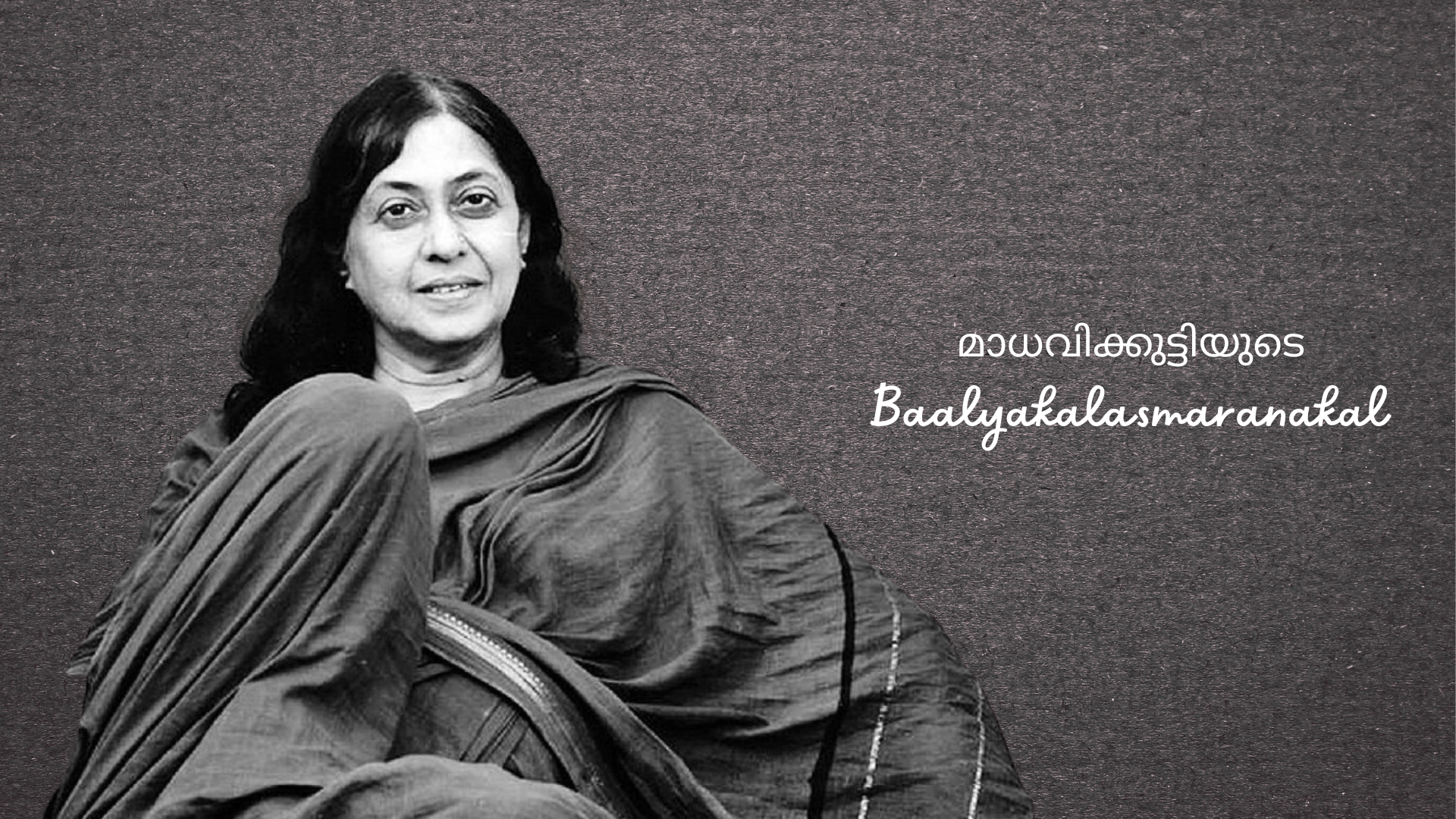
Madhavikkutty’s Baalyakalasmaranakal ( Childhood Memories)
Amid this blur of change, my father handed me a book, Baalyakalasmaranakal by Madhavikkutty (pen name of poet Kamala Das). I can’t quite recall if it was before I left for boarding school or during one of his visits, but I remember each chapter like an old friend. It felt oddly familiar to a child who found solace in her mother’s home. The protagonist (the author herself), another seven-year-old, spent her days wandering around the house, asking questions no one seemed to answer, clinging to her grandmother while always sensing a distance with her parents.
Her words were raw, unpolished, and disarmingly honest. The book was certainly not meant for a seven-year-old. Unlike the sugar-coated fairy tales that lulled me to sleep, this one kept me up at night. It spoke of casteism, untouchability, matriarchal societies, the male gaze, and the taboos surrounding love, all seen through the eyes of a child. For the first time, I realised how, even in the early days when polygamy, untouchability, and casteism were prevalent, women in matriarchal Kerala had the freedom to decide their fate.
The simplicity of her perspective made these harsh truths even more powerful, stripping them of any pretense or polish. It was an unsettling and strangely comforting world, a reminder that honesty, however bitter, was far more soothing than the sweetest lies.
Over the years, she transformed from Madhavikkutty to Kamala Das to Kamala Suraiyya, but never stopped being Aami, the small, brown, wide-eyed girl from Punnayurkulam. Those nights, beneath the dim light of the boarding lamp, I found a companion in Madhavikkutty and her words, raw and untamed, echoing the questions I never dared to ask aloud. It was as if the book wasn’t trying to shield me from the world but rather inviting me to see it as it truly was, without apology or disguise.
The books I have read over the years have shaped the way I write, and perhaps without realising it, they shaped the way I live. Of course, Madhavikkutty’s influence runs deep. In the corporate world, where everything has to be optimised for clicks and SEO, a storytelling style is not always welcome. But it’s the only way writing feels true to me. That’s why, despite my degrees in journalism, I never went into hardcore journalism and became a feature writer instead. Weaving words into stories that, if nothing else, felt honest.
This is for those writers who stayed true to their language and origins, their words still echoing in our conversations, in cinema, in the nostalgia of those who grew up reading them. If I ever write, I want to write like that. Without pretense, without dilution. Words that cut straight to the core, whether in English, Malayalam, or whichever language feels most like home at that moment. Because the only words worth writing are the ones that can’t be unwritten.
 An Insomniac's Musings