The Wailing Wall

27tdrm1

Pic: Manu R Mavelil

  Pablo Ibbieta has been awaiting his death. On that God forbidden night he spent with his comrades – Tom Steinbock and Juan Mirbal – he had severed all his ties to the outside world. Neither his love for Concha nor his loyalty for Ramon Gris stood no chance. But as irony would have it, death evaded him and left him to feed on his guilt. The Wall – a cult classic from the French litterateur, Jean-Paul Sartre – thrives on the existentialistic philosophy he endorsed throughout his writings. The title referred to the wall where the prisoners were lined up and executed during the Spanish Civil War.

What would run through the minds of people awaiting their nearing death? Sartre, a hardcore existentialist, deftly brings to light eclectic human emotions in his portrayal of people serving their time inside the four walls of a cellar. A bunch of theatre aficionados from Kanal Samskarika Vedi, is revisiting this story in their latest play ‘Chimera’.

Aromal T, has written the Malayalam script adding his own takes on the subject. The doctor, who becomes a silent participant of the trio’s agony in the story, is much more strong and menacing in the play.

27tdir1

Hasim Amaravila

“The wall is a story which is relevant in all times. The play is written taking into account the current political scenario across the globe so that the audience could easily identify with the characters and their circumstances,” says the director of ‘Chimera’, Hasim Amaravila.

A story based on the Spanish Civil War, The wall (1939), had made a massive impact on the human kind across the globe, with its cold yet heart-wrenching portrayal of prisoners. At a time when wars and civil tensions were as common as rainfalls, the story was easily relatable to many those days.

Falangist forces operating under General Francisco Franco takes Pablo, Tom and Juan as prisoners. Juan, the youngest of the lot, cannot come to terms with the fact that he is a convict as he firmly believes he is innocent. Ratheesh Krishna painstakingly essays the role of Juan, who agonises on his misfortune. While Tom, who doesn’t want his fear to be apparent, keeps jabbering about death, often irritating his fellow prisoners. Santhosh Venjaramoodu, a known name in the theatre circuit, reprises Tom in his signature style.

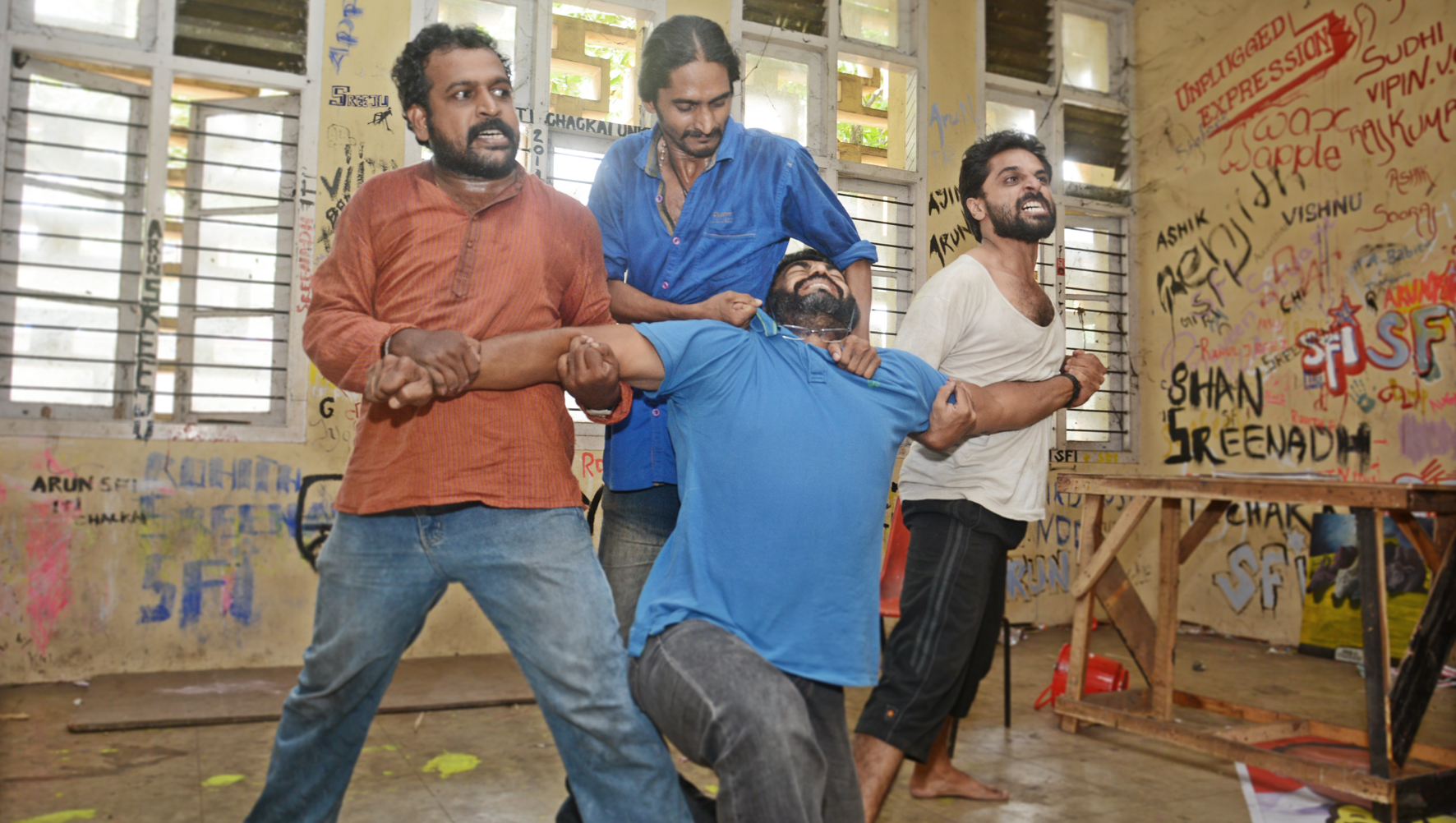
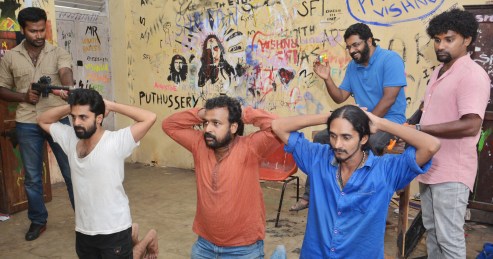
On the fourth and final scene of the one-hour-long play, the biting cold seeps through the cellar, but the prisoners, who are immersed in their thoughts are sweating profusely. This is when the doctor (Arun Nair) enters the cellar offering them help to get out of their mental misery. But the prisoners find his presence annoying and manhandle him. When the army rams in and asks for Tom and Juan for the execution, the time was 3.30. Pablo, the protagonist, (Kannan Nair), who was awaiting their entry wakes up from his chimeric state and prepares to go with his friends. But the army stops him. They tell him his time is not up yet. He listens to the multiple gunshots while awaiting his turn. But they give him a proposition instead. They ask him for his friend, Ramon Gris’s whereabouts, in exchange for which they offered him his life. Pablo, unintentionally gives the 27tdrm2address of Ramon’s hiding place, thinking he’s safe in his cousin’s house. Thus Pablo, who had prepared to die gains the freedom he didn’t want. Kannan’s Pablo guarantees to stay in your heart for many years to come. The pain he feels when he comes to know that he has unknowingly betrayed his friend, is palpable. Hasim executes the scenes adeptly making the
 play an interesting watch.


The Swanky Headgears

 301070_274253432608010_1812688817_n   The ingrained liaison between man and his mean machine could date back to the day he invented ‘wheel’. The only time a heterosexual man may exhibit his emotions other than seeing his baby for the first time, could be when he talks about his motor bike. He may talk nineteen to the dozen about the treasure hidden beneath that sheath of metal. Once he attains the sheer bliss of owning his dream machine, the next stop is helmet shopping.

No doubt, the power-packed motorbikes customised in vivid race insignias need a similarly stylised head gear. The carnal hunt for the edgy helmets will persist until he lands the right one. The beacon of style for most race fanatics is riding guru ‘Valentino Rossi’. The replicas of his motorbikes and helmets are churning out like hot buns in many a garage in the city.

“I am a big Valentino Rossi fan. His signature helmets are a source of every man’s envy. I had a design of one such helmet with me. When I approached ‘Ghost Ryderz’ a motor cycle stunt team, who also does automobile customisation, to make a replica of the same, they took up the challenge. They had to use around 18 colours on my helmet,” says Mobin Thomas, who had spent around Rs 7,000 for his dream head gear.

‘Retuned’, a company owned by final year engineering students Akhil Ganesh, Vishnu B K and Yedu A Krishnan, is one of the most sought-after automobile customisation centres in the capital city. Their adeptness in style and clean designs are tested on helmets as well. 298018_2611539126204_678650314_n

“We basically do automobile customisations. Our first customers for helmet designing were the bike riders who customised their bikes from us. They wanted matching designs for both helmets and bikes. Later on requests for helmets started pouring in. Now we get around 6-7 requests per month for helmets,” says Akhil.

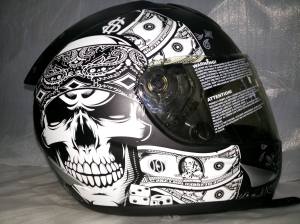
In the early nineties Mollywood dabbled with helmeted antiheroes, giving the helmet a negative touch. The classy sunglasses were the only adornment for motor bikers then. Helmets went through an image make-over in 2000’s with the law enforcing its usage. When the suave men go for sleek-sheen blacks, the machine junkies are all for colours. Skulls, graffiti designs, icons (Che Guevara) and even flags are inspirations for the youth.

Auto Queen in Kochi is a riders’ paradise with imported helmets and accessories taking centre stage. From the lackluster equestrian helmets to the Thailand-made THH, there’s nothing Auto Queen does not offer. Automobile junkies from across the state buy bulks from Auto Queen and give it for personal customisations. The shop which was established in 1972 is currently managed by Sabu.

“THH is a helmet company which is available only in our shop in Kerala. Our helmets range from Rs 800-30,000. Riders of R15 and Harley Davidson are ready to spend any amount of money for the right one while there are many others who buy the least expensive because that fulfills their requirement,” says Sabu.

1048905_487452047998240_601738504_oGhost Ryderz’ a motor cycle stunt team in the city is known for its daring stunts and spunky customisations. Rakesh, the artist of the team does the graphics work on cars, bikes and helmets. “We have done around 30-40 helmets in the last 3-4 years. Even before helmet law was enforced the riders used to come for painted helmets. They mostly ask similar designs for bikes and helmets. There are many who come with pictures of famous helmets worn by international riders and ask for replicas. For personal touches some ask to imprint their names or parents’ names on the helmet,” says Rakesh.


Rakesh says the safety is never tampered in customisation. When asked about women customers, both Rakesh and Akhil had the same answer “never had any women customers for helmets”.

Nonetheless, Amrutha, known for her bravery towards eve teasers and an ardent bike rider says she would like a customised feminine helmet for her ride. “There’s a belief that women cannot handle bikes so to represent femininity I wanted to paint my bike pink. I even had a pink Hanna Montana helmet, which I had customised. I am planning to buy a new bike and paint it pink and to match with it I will customise my helmet as well,” Amrutha quips.1255495_10151798720839476_859798700_n

‘Helmet World’, the new shop in the city claims to fulfill all rider needs with its range of helmets, gloves and jackets. Bike junkies, Hareesh and Rakhin have started the venture to promote riding across the city. “There was no good shop for riders in the city earlier. So we wanted to give something new. We have a range of DOT (which meets the international standards) approved helmets in our collection. The graphic designed helmets have many young takers. There are many who have come for an Rs 800 range helmet and have returned with Rs 8,000 ones seeing the style and safety of the models,” says Hareesh.

Though it has raked its share of dust, the swanky helmets are becoming the new fad in town. Vishnu who has customised his helmet and bike says, “Uniqueness was what I was looking for when I customised my bike and helmet and that is exactly what I got in return.”   white Red

Dancing the Dream

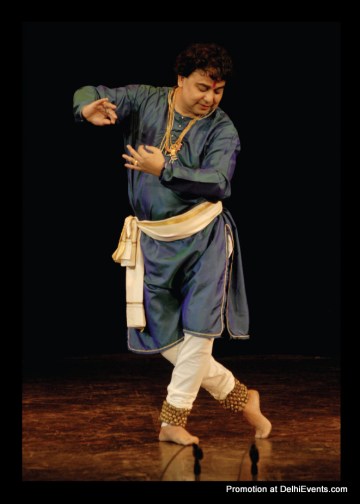
Jayant Kastuar 1  Jayant Kastuar lets his dance do all the talking. Mesmerising the world with his delicate hand gestures, seamless spins and intricate footworks, this maestro imbibes the sheer beauty of Kathak with elan. Sashaying from one stance to another in gay abandon, Jayant’s fluid motions, kaleidoscopic at times, bring out the intrinsic ease of Kathak before the audience. This acclaimed dancer, who had clinched myriad national and international plaudits over the years spares some time for the City Express on his visit to the capital city.

“Kathak is not only about the ‘Nritya’ and the footworks involved with it, ‘Abhinaya’ (acting) is also as important. When one venture into Kathak, he should also take into mind that it is also his first step towards spirtiual enlightenment,” says Jayant, who was touted as a dance prodigy in the 1960s.

Hailing from Jamshedpur, a melting pot of various cultures and traditions, Jayant’s entry into the art world was predestined. Jayant was the tenth and the youngest child of his parents, who inculcated rich traditions and love for art in their children.

“I must have started dancing the day I was born. Because I was born into a very culturally-rich family where everybody was learning one artform or the other. My mother was the daughter of a prominent leader from Bihar. She belonged to a family jayant_kastuar_dancerof social leaders and my father was a Zamindar. My mother could do all the ‘yogasanas’ until the day she died. So they were quite particular about their children learning an artform. When my sisters learnt Odissi I was pulled into Kathak,” says Jayant, who first performed before an audience at the age of two. It was his rendezvous with the legend Pandit Durgalal, while he was still very young that turned Jayant’s life upside down.
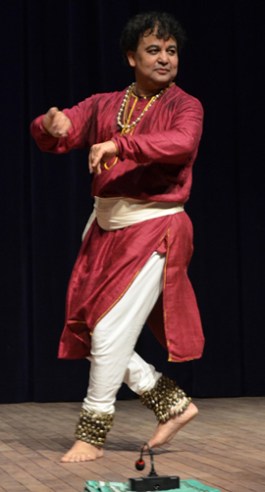
“I had the rare opportunity to learn from Pandit Durgalal and I consider it my biggest blessing,” says Jayant. Jayant, who follows the Jaipur Gharana, is often known for his authentic presentation of his Guru’s methods before the audience. However, he has developed a unique style that accentuates abhinaya while doing other Kathak nuances.

Unlike other dedicated artists, whose academics rarely match up to their stage persona, this dancer who studied history from the St Stephen’s college secured top scores during his post graduate studies. Later on, he did doctoral studies in Buddhist art. This quality, could have been the reason why he was sneaked away from the college to serve as the head of the dance department at Sangeet Natak Akademi, National Academy of Performing Arts, when he was barely 29. Later in 1999, he was promoted as the Secretary of the Akademi, where he served for another 12 years.

“The Akademi duties were taking away the time I should have invested on my dance. I was not able to perform at the Akademi conducted functions fearing the criticism that the secretary himself is performing at all the events. So in 2011, I resigned from the post,” says Jayant, who has been conferred with national and international honours such as Nritya Choodamani, Natya Padmam, Nritya Shiromani, and a felicitation from New York city council.

When asked dance was commonly perceived as a woman’s art, he says, that is a misconception as all our Natyacharyas (Dance teachers) including Nattuvar and Nataraja are men. “Look at Kathakali for instance, even the female roles are played by men even today. Kathak has been a male art to begin with, especially in Rajasthan from where the Jaipur Gharana comes from,” says Jayant.

p5aHe feels current climate is quite favourable for dance as media and the reality shows give it enough popularity. However, he feels that dance should find the right balance without falling prey to commercialism.

“Just like the Britishers, America is also trying to colonise third world countries with an overdose of American programmes. By showing their second grade movies and TV programmes they are inculcating violence in our children. That is something one should be aware of,” says Jayant.

He leaves us speechless with his knowledge of indigenous Kerala art forms, Koodiyattom, Nangyarkooth and Kathakali. His observations are bang on, easily revealing his profound sense of awareness about dance, his sole passion.

Addicted to Addicts

 functional-alcoholic  “My wife is an alcoholic. Best person I ever met. She has 600 different smiles. They can light up your life. They can make you laugh out loud, just like that. They can even make you cry, just like that. You’d have to see her with her kids. To think of all the things she lives through, and I couldn’t help her. I tried everything, except really listening and that’s how I left her alone,” says Michael Greene (Andy Garcia) in the movie ‘When a man loves a woman’. When you love a person, you love them no matter what. Their weaknesses become yours and their diseases your worries. What if your loved one’s penchant for alcohol makes you taciturn and your ineptness become evident? What if your own children see you as inadequate and drown themselves in inescapable indulgences? Michael Greene could be you, a helpless partner, mother, sibling, daughter or just an acquaintance of an alcoholic.

Many of you are aware that alcoholism is a disease and an alcoholic addict is a patient not a demon, but, what you may not know is by sharing a home with an alcoholic, you are becoming a patient as well. Your disease can vary from depression, insecurity to just worry. Al-Anon, a fellowship that works hand-in-hand with Alcoholic Anonymous (AA), for the relatives and friends of alcoholics to share their distress with similar-minded people, is where you could shove those discomforts. Al-Anon with its 62 groups around the state has been providing solace to alcoholism-ridden families for the past 16 years. An alcoholic-addict do not need your criticisms, instead, your caring and understanding is what he needs. You need to change yourself rather than trying to change them and Al-Anon teaches that.

“My son started drinking when he was 13-years-old. We thought we had given him everything he needed. But we didn’t see him slipping through our very own hands. When he became addicted we were confused. I went into severe depression. He dropped out from the engineering college and became a taxi driver. Soon his friends took over driving while he slept on the backseat in an inebriated state. Our family had gone through hell,” says Saraswathi, an Al-Anon member from Koyilandi.bigstock-A-group-of-people-discussing-t-39786376

Saraswathi and her husband had taken their only son to every de-addiction centre they had heard off, but once out of the centre he went back to drinking. But soon AA meetings came to their rescue and had helped them immensely since.

“By the time my son started attending AA meetings, I had become too weak and depressed. We were witnessing a case like this for the first time. So when he came back as a new person, we were unable to stand the withdrawal symptoms he had shown. And as we were from a well-known family from around the area, I could not confide it to anybody, thus I became a member of Al-Anon where I found people who had endured similar situations. There I realised that the way I behaved to my son was never fair, I could have been more gentle and caring. Instead, all I did was finding his mistakes and berating him which made him run towards alcohol more often,” says Saraswathi.

If Saraswathi has been going to Al-Anon meetings for the past five years, Shehnaz’s stint with the group started 15-years-ago. It was her husband’s alcoholism which started with one or two pegs at office parties that made Shehnaz search for de-addiction centres and her search ended with AA. At AA she found people like herself, who love their husbands dearly but cannot get them out of this god forbidden habit.

“When you are in such a state it will be your relatives that take initiative in taunting you with accusation. They will corner you and say it’s all your fault. Today when I think about it I don’t know how I had overcome that. The atmosphere at home turns sore because of his habit and there’s nobody to turn to,” says Shehnaz, Kozhikode.

Today, Shehnaz is one of the most passionate members of Al-Anon who follows the groups’ activities avidly. Kozhikode and Wayanad have the most number of Al-Anon groups around the state.

img_3845-copy“The change should come from oneself,” says Fathima, a member of Al-Anon from Wayanad. Fathima was married off at the age of fourteen and at a tender age she had to endure the traumas caused by alcohol. “At first, I couldn’t digest his drinking but when the doctors said it is a disease I was relieved. Because I preferred the term disease for alcohol addiction I guess. But even after treatments he went back to drinking, making me lose confidence in treatments and even God. But a member of AA came to our house one day and made us aware of its methods. But the withdrawal symptoms he had shown were intolerable and I told the AA member about it. I thought the state was better when he was drunk. But the member gave me a phone number directing me to another wife who had been going through the same situation for years. That is Al-Anon. The relief I felt after talking to her was quite amazing and soon the wives and relatives of AA members started an Al-Anon at Wayanad,” says Fathima

The pamphlets and books given at Al-Anon were in English, Fathima who couldn’t complete schooling found it difficult. Thus she started learning English. Today she can read and write English like other elite members. Fathima says it is the children who end up suffering the most in an alcohol-ridden family. Her son who was adept in sports never took it up as he wanted to be with his mother and sister all the time. He couldn’t pass his tenth in the first attempt but today he has gained 83% in his MBA.

o-WOMEN-HOLDING-HANDS-facebookMini, a government employee from Thiruvanathapuram, is one of the newest members of Al-Anon. It has been five-months since Al-Anon has started in the capital city and Mini was one of the founder members. It was with her husband Mini first came to an AA meeting and soon the need for Al-Anon was raised by the relatives thus came the first Al-Anon in the city.
For teenagers AA has another fellowship called Al-Ateen, where the children ranging from 11-19 can share their experiences. Al-Anon was formed in 1951 in New York by Anne B and Lois W, wife of Alcoholics Anonymous (AA) co-founder Bill W. Today it has branches in around 225 countries. The Indian Head Office is in Mumbai called General Service Office (GSO).

(The names mentioned above have been changed for anonymity) Helpline numbers of Al-Anon: 9349810022, +919349910022

Going the Quirky Way

DPU_1935

BP Deepu

  A pop of colour on eyelashes, sun-kissed shades on hair, multiple body piercings, it is no news that new-gen kids are on an experimenting frenzy to stand out from the monotonous Malayali crowd. Jaded with age-old set rules, they are flexing their sartorial muscles in an attempt to be whimsical and quirky.  In style-statements that could chagrin their predecessors, these youngsters are fashioning their very own ramps. Seeking the one look that could kill, these youngsters ditch the must-haves and embrace the quirkiness. When girls try out men’s multi-colored lungis, body piercings and tattoos here and there, a few guys do not mind spotting with nose-rings and bangles. There’s no question of ‘what is en vogue’ with these youngsters as ‘they just don’t care’.  

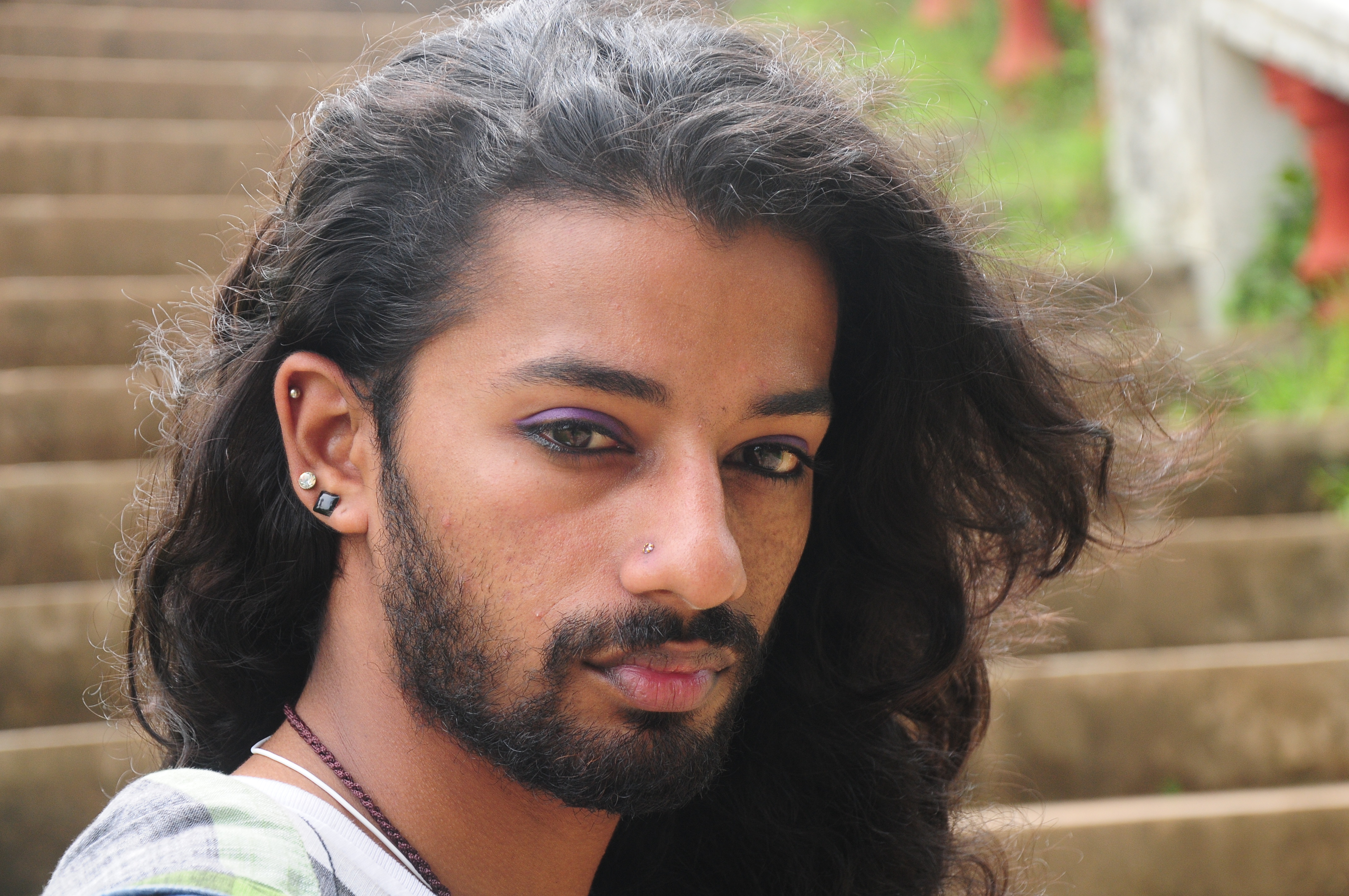
A permanent nose ring, multiple earrings, some bangles and bracelets, a few chunky chains, and a dash of eye make-up, Akhil is good to go. Being a theatre artist, this youngster yearned to stand out from the crowd and eventually stumbled upon this style. His eye-make up could bring any fashionista’s eyes to shame with the eye shadows smoothed in perfection. The long, coloured mane is either in a knot or flying with the wind. In his yen for uniqueness Akhil breaks all conventional codes and attempts a path much less traveled.

“I have started trying out these new styles a few years back. When I first started wearing make-up my friends encouraged me saying it suits me. Today I have an array of eye shadows with me and many of my friends who are girls come to me for make-overs and as far as I know there’s nobody who is quite like me,” says Akhil.DPU_1957

Today when the ‘ferosh’ (ferocious), ‘swag’ and ‘adorbs’ (cool in urban slang) adorn the haute couture glossary, the clichéd ‘chic’ and ‘in’ have become words of the past. Hence, the young do not hesitate to let their hair down while endorsing a daring yet unique countenance.  The odd-one may rule the roost, if the world allows him to be.

For Arun Manohar, a known-name in the Mollywood costume designing circuit, this is not a new fashion fad. Arun, who likes to experiment with his own looks, recalls a classmate of his from his fashion school days, “I have had a friend who wore his hair in dreadlocks and had tattoos all over his body. He had a daunting look about him, but once the ice was broken, there’s no simpler and sweeter man than him. Though I have never gone thus far, there are times I have tried out many quirky styles I have come up with myself and in my home town it did make waves.” Arun, who had worked in around 25 Malayalam movies as a costume designer, today tests those fashion quirkies on his models.

“What is different about me?” asks Kani, a cine actor and theatre artist, who likes to wear lungis as her casuals. “I don’t purposely dress to look different. Comfort is my priority. I have been brought up by my grandparents mostly and it is the comfort element of cotton lungis that has attracted me to them. Earlier I used to stitch salwars with them; nowadays I wear them as it is. But it has nothing to do with standing out from the crowd. It is more of a preference. Sarees, lungis and skirts are my preferred attires in Kerala rather than jeans,” says Kani. “There are times I have shaved off my hair to escape from the heat. But these are my personal choices and has nothing to do with a judgmental onlooker,” says Kani

IMG-20130821-WA0000According to Kani, except the middle and high class in Kerala, the common crowd wears whatever it likes. “When I see the ladies who work on fields and roads, not worrying about their modesty even in their actions and gestures, I wish I had that kind of freedom,” says Kani.
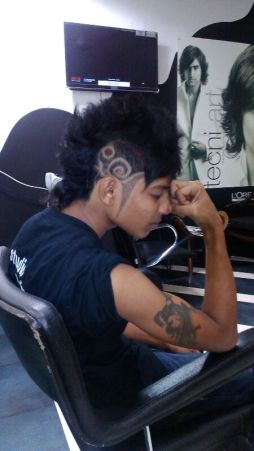
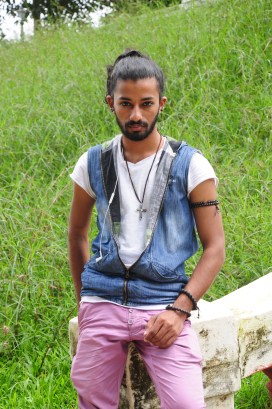
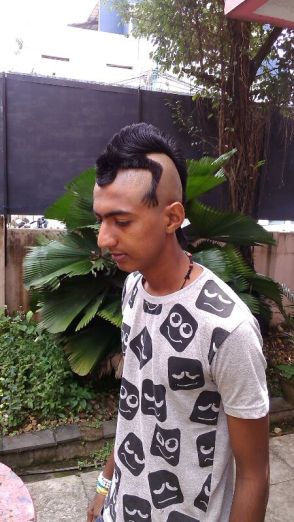
For Aromal, a school teacher, who finds solace in his Jeans-T-shirt avatars, it is the occasional leaps to eccentric turnovers that make him different. Not following the preset rules meant for teachers this youngster often likes to experiment with his looks by trying out a unique hairstyle or a weird beard.

“I don’t want to look like every other Tom, Dick and Harry, and it is that instinct that makes me try new styles. But for clothing I stick to major brands. Today, being a teacher limits my options but earlier I used to try out different looks often. Every day my look changes and hence not many can identify one from another,” says Aromal

Sooraj, a tattoo parlour owner in the capital city says, more than college students it is professionals who come to get a permanent mark in their body. “It was surprising for me at first, as people flocking my parlour were mostly professionals than the so called ‘freaks’. Lawyers, doctors and IT professionals come to the parlour for rare and unique designs,” says Suraj.

Diya’s obsession with black is what took her to a new level, the gothic. A stickler for style, this seventeen year likes to indulge in black eye make-up to pitch black nail polish. Her long straightened hair is auburn-coloured in places. The monotony of the black shirt and black jeans combi is broken with a long silver neck piece having a large skull pendant. Chunky silver rings adorn those black-tipped fingers.

“I didn’t start wearing black to prove anything. It is something I liked. Then people started telling me that it is this or that. But I didn’t purposely choose gothic style,” says Diya.

Vinuju Nizar Yusuf is the quintessential cool dude, who does not believe in walking with the crowd, instead he likes to give unique signals that defines him. His multiple tattoos- (a smiley and yin yang, which he designed by himself) earrings-and-harem pants look is something he came up with himself. Being an IT professional, Vinuju has to wear formals during weekdays.

“I hate trousers and pants. My favourite day wear is harem pants or shorts. I don’t believe in set rules. People should have IMG-20130826-WA0000
the freedom to wear whatever they like. It is not my parents but onlookers who have a problem with my dressing but I kind of enjoy it. They come and ask me what I am wearing and have a conversation with me. Being a people’s person it never bothers me,” says Vinuju, who says his mother likes to sneak out his earrings for herself so he prefers not to wear them at
home.

He says two of his best buddies, who hail from the capital city shares the same thoughts. They make a sight for the capital’s crowd whenever they get together outside office.

“We want to break conventions in a state like Kerala. Everybody should have the freedom to wear whatever they like and I hope some day Kerala crowd will become more open and accepting, says Vinuju.

In short, these youngsters send out a message in clear-cut block letters, ‘what we do is none of your business’ and let’s just wait and see, the times will prove they are no wrong.