
Tracking Race History

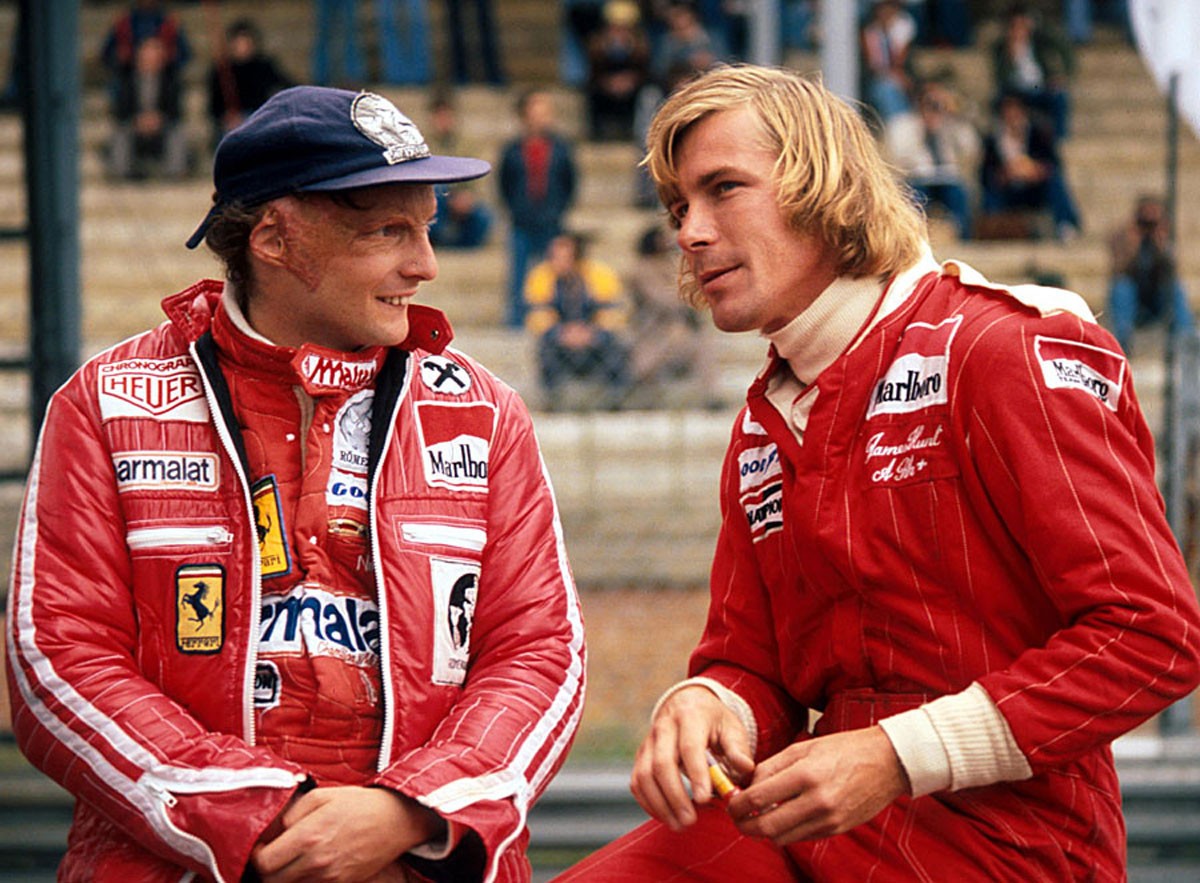
James Hunt and Niki Lauda  The speed-junkies remember them for the sheer skill they exhibited on the race-track. Their rivalry was the talk-of-the-town in the late 70s that even Hollywood celebrated it in their big- budget action caper ‘Rush’ last year. Neither sticklers of protocols nor afraid of speed, they rewrote history with their impeccable driving style. Niki Lauda and late James Hunt, the racing giants, who wowed the audience by taking Formula 1 racing to another level, would be only too happy to see their sons joining hands at the track this year. At MRF Formula 2000 Championship to be held at Qatar, Freddie Hunt And Mathias Lauda will come together for the first time for M&N Racing, a team owned by city-based racing fanatic Jose Pottamkulam alias Ootta. But what is more interesting is that Jose would be canning the candid moments they share together for his documentary ‘Sons of Speed’.

Jose PottamkulamIt was interesting to see their sons bond while their fathers were of extremely different temperaments. While Hunt, a British man, was extremely flamboyant and a playboy, Lauda, an Austrian was extremely serious about his profession during his heydays. Lauda had met with an accident while driving that left his face permanently disfigured,” says Jose.

Jose’s documentary being written and directed by Navneet Prakash will record the racers’ day-to-day preparations, trials and the lifestyles. Jose says that the the purpose of the film is to showcase the passion that the two drivers have for racing.

We would be discussing their routine, their dedication, the trials and tribulations of motor racing, the impact of their father’s legacy, the behind the scenes account of the racing championship, the intense competition,the drama, the excitement of racing and much more,” says Jose.

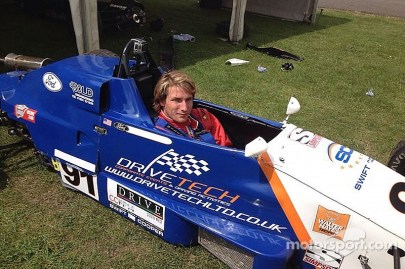
But Jose does not forget to mention that the sons, especially Freddie Hunt, are not into racing as much as their fathers. tumblr_inline_mum6qoFuWJ1r2a6amHowever, he expects them to keep the legacies of their fathers intact.

The documentary will have personal interviews of Freddie and Mathias focusing on how they got into racing. The makers are also planning to include comments from other team members, racers’ family members and friends, a senior member from JA Motorsport and a racing historian. Jose would be recounting his personal experiences which he had with the racers for the film as well.

Even though Hollywood has already captured the lives of Lauda and Hunt in their movie ‘Rush’, I wanted to show the camaraderie their sons share on track as well as real-life. As they would be racing for my team, it would be easier for me to lap up such precious moments,” says Jose.

Only time can say if the sons can recreate the gravity-defying spins and turns their fathers were famous for. With the same level of anticipation and dizzying adoration fans are awaiting the Lauda and Hunt reunion at the Qatar soil.
freddie-hunt-As we cannot predict the outcome of the races, we will be scripting and planning the film’s story as the championship progresses. The film’s flow will be based on the championship results,” says Jose. Divya Menon is the associate producer of the film.
Caught in the Vagaries of Life

Book cover
The more I tried to love

The more I was left out

The more to injustice I bowed

The more it made hatred sprout

All around me was unfair strife

And here I was paying with my life

– Rajshree Raajgopal

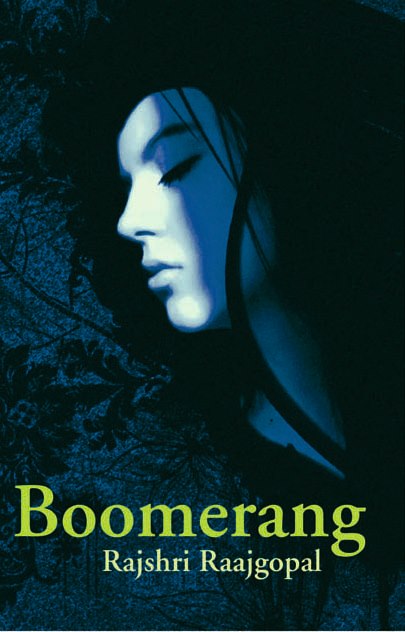
It is not everyday that you come across a book that keeps you glued to its pages till the very end. Good fiction written in flawless English is also a seldom occurrence in Kerala. But, Rajshri Raajgopal’s ‘Boomerang’, written in impeccable English, will affiance you till page 225, with its refreshing story line. Boomerang, even though falters at times in terms of theme, is one such book, which easily prompts the reader to join the protagonist in her exacting journey.

Divulging the travails of a woman, that too a Malayali woman, Rajshri Raajgopal sets out to unearth the passion and longing hidden beneath a woman’s stiff exterior. In an explicit sketch of Anna trapped in a loveless marriage, Rajshri takes a dig at the Kerala society, where millions of women endure the woes of their marriage fearing social wrath.

Scrawling the pangs, passion and tribulation of Anna Subramaniam, her protagonist, Rajshri deliberates the readers to introspect on how our society treats women. By letting you into the inner turmoils, emotions and yearnings of Anna, Rajshri denotes that even educated women do not have the freedom to raise their voices in this society. Since the book is a first person narrative, there are instances when you could see glimpses of Rajshri in Anna.

Anna Subramaniam pined for love like every teenage girl. She longed to dance to its rhythm and be lost in its contours. But the vagaries of love take a toll on her convictions from the very first taste of it. But she clutches on to her dreams, often falling short of breath in the process. When her first love leaves her to lick her wounds in desolation, her husband makes her lose belief in love.

RajshriAnna had to bear the brunt of her inept parents – an alcoholic father and a submissive mother – while growing up. Her Christian mother, who fled with a Hindu man in her teen years, was still a sore in the eyes of her relatives. Later, when her father leaves them to destiny, Anna finds a job at a five-star hotel. There she meets George, who marries her eventually. George, his parents and his sister found her presence interfering with their privacy. For them, she remained an outsider. The succeeding events lead to a miscarriage leaving her devastated. She later finds solace in Dev, an acquaintance of George, who married her and treated her like a queen. But the story doesn’t end there. When Dev, her dream man, sashays into her life, the desperate romantic in you may hope against hope for a happily ever after for Anna. But the darkness, lurking behind the closed doors of Dev’s house, is all ready to strike at Anna’s weakest moments. Rajshri succeeds to keep the suspense alive till the end, making the reader find the name of the book, aptly given. The author does not refrain from illustrating vivid sexual sequences between her and Dev, implying there is nothing wrong in women craving for sex.
Rajshri delineates flashes of Anna’s emotions, the people she meet and the traumas she brave out in simple poems that easily pique your intrigue. Anna recalls the moment she met Maya for the first time in a crisp poem. An aura of mystery masks Maya till her identity was revealed in the tenth night.

I stared at her, beautiful but wan

Among the dead the like of a swan

A sight so true yet so rare

Not to shock or shake or scare

But to teach realities so stark

To kindle a fire with one little spark

Of love for life that she had lost

That was with me, now valued most…

Rajshri, hailing from Thrissur, picks the capital city to play the backdrop of her story.
Boomerang is Rajshri’s debut adult fiction. She has written numerous children’s books for Mimitra enterprises.

To Australia, With Love

   sedunath (14)For a rank outsider, who knows Australia from the movies and cricket matches, it is the land of Hugh Jackman, Shane Warne and koala bears. But, the little known factor is that it is also home to 500 or more indigenous aboriginal tribes, the oldest in the history of the world. This small continent revels upon such exquisite traditions hidden beneath the picturesque view of its snow-capped alps, lush greens and the deep blue sea. Beyond its contributions to cricket and cinema, Australia has a remarkable tale to recount from the time Dutchman Willem Janszoon discovered it in 1606. Sedunath Prabhakar, a Malayali, who took off to Australia in 2008, to pursue art, has done extensive research on Australian history and translated it into a 50-metre-long canvas. Engraved with the portraits of 50 Australian personalities from various walks of life, who had contributed largely to the country’s betterment, Sedunath’s oeuvre is the first of its kind in the history of Australia.

This painting is my small attempt to narrate the Australian history through art. I am planning to exhibit it on November this year at Melbourne. My researches included interviews, books and historical references to get the exact information regarding the people. It took 1.5 years to complete the work done in acrylic,” says Sedunath.

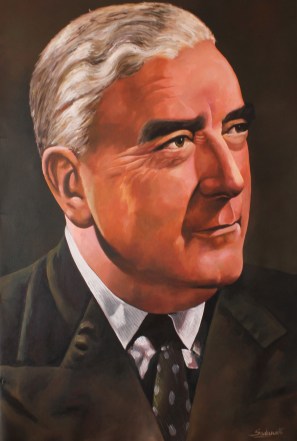
Sedunath painstakingly handpicked personalities, who made waves in the country, starting from the 1700s to late 1900s. Impervious to the effect she had on the viewers, Emily Kame Kngwarreye flaunts her lopsided smile and looks up from Sedunath’s canvas. This aboriginal painter was one of the most prominent contemporary Indigenous Australian artists in the world. Following her comes John Monash, who played a cardinal role during the First World War, with his commanding IMG_8024 (1)abilities. Sedunath doles out spaces for Patrick White and Elizabeth Blackburn equally, the Nobel prize winners in literature and medicine respectively and also paints Robert Menzies, a man who won prime minister post twice.
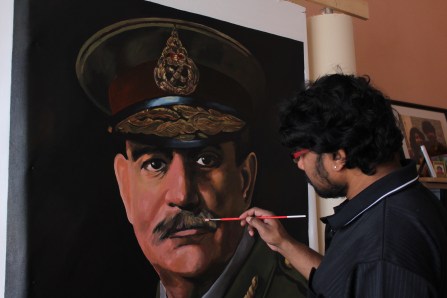
Sedunath, a full-time artist at Melbourne gained a newfound mojo in Australia, where he conducted multiple group shows.

I got a chance to participate in four group exhibitions in Melbourne, Australia. The first exhibition was conducted by Dandenong Art community for the ‘standing at the cross road’ award. I won the first prize from the 200 non-Indian participants. I am happy to be the first Indian who won this award,” says Sedunath.

Back in the day, when Sedunath was just Pradeep Prabhakar (his official name), he strived to carve a name in the Kerala’s art scene. Being a full-time artist in Kerala was never an easy task. He resigns to a brooding mood when asked about his struggling days in Kerala.

In Kerala, people don’t appreciate original art. They are looking for copies. I could not make my ends meet with just art. I had taken up a job as a graphic designer,” he recalls. He moved to Gujarat after his degree and in Baroda he found his destiny.

My brother was in Gujarat at the time when I went to Baroda. There I got a chance to paint Jain history in one of their temples. The priest who gave me the assignment spent a lot of time with me to narrate the wide history of Jainism. That is when the world looked up to notice me,” says Sedu. He was given the ‘Hemaprabhu Guru’ award for his massive work on Jain tradition done on oil paint. Later, he did his fine arts degree from the prestigious Baroda School of Art, where he gathered a broader perspective on life, the complex aspects of human society and more.

When asked what inspires his works he says, “The relationship between the nature and human beings is a recurring theme in my works. My works also explore the intricacies involved in religion and its interplay with society. Like all true artists I usedIMG_7543 to draw inspiration from tradition especially its parallel streams.”
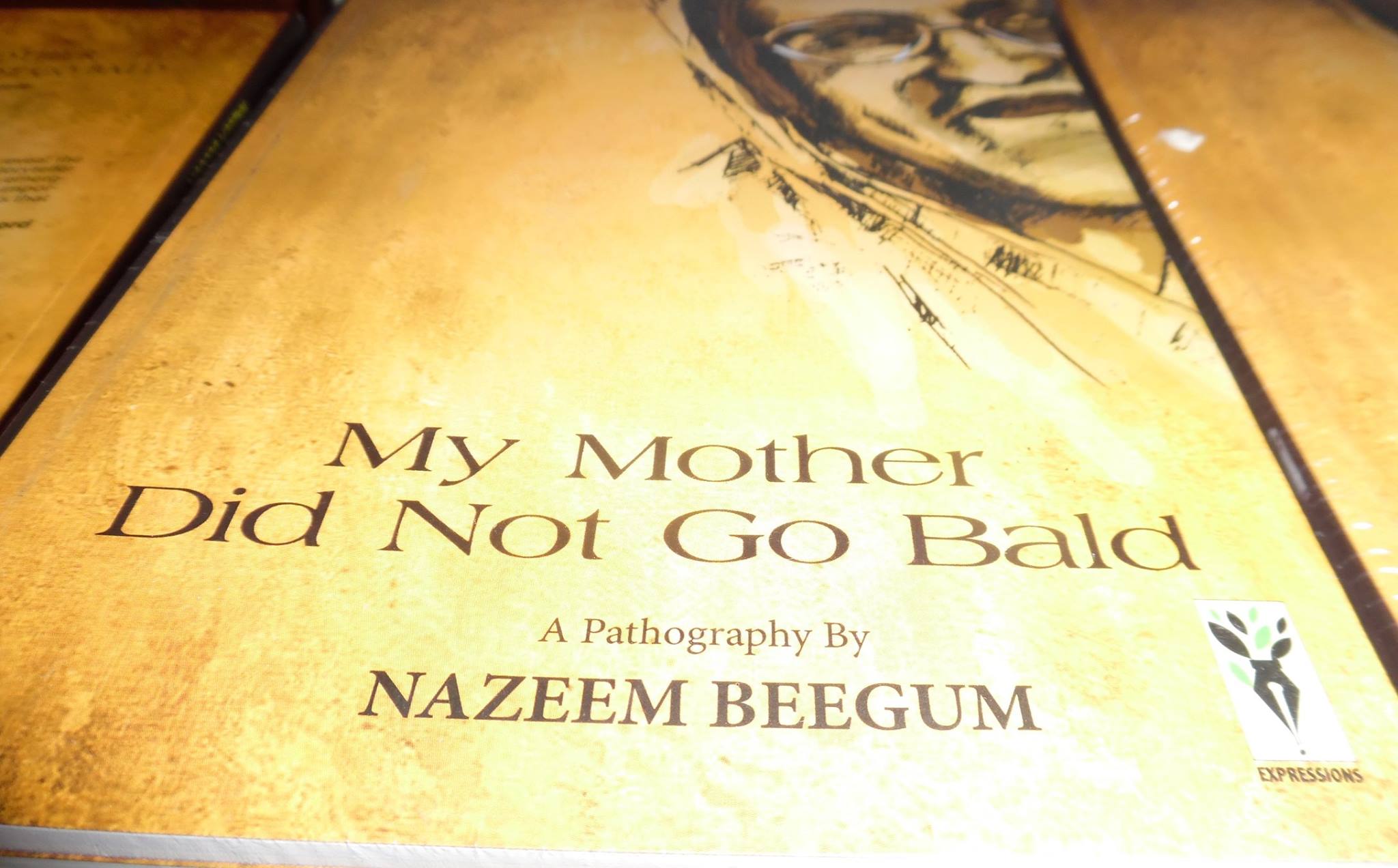
Sedunath’s interests are not limited to just art. This multi-talented artist, who has a black-belt in Karate, also dabbles with literature and Carnatic music in his spare time. Sedunath has a novelette, Bhroonam, published in 2001 to his name as well.

Sedunath plans to delve deep into the rich artistic tradition of Australia and integrate it with his own during his stay in the country.

A Song from the Broken Heart

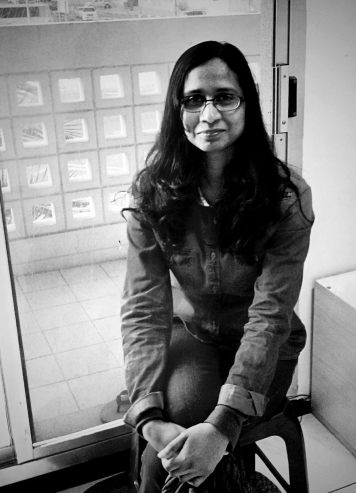
1899363_10205158371664775_3833361099093830511_oAll through her exacting journey of watching her mother, Sainaba, succumb to cancer, Nazeem Beegum was just a bystander. A bystander, whose silent agonies went in vain before the persecuting and prejudiced health system of the state. Nazeem, an expatriate journalist, who spent her days and nights tending for her beloved mother, could not come to terms with the callous reception from most major medical institutions in the state. But, they found solace at the doorstep of Pallium India, where she met the gentle visionary, Dr Rajagopal. It was by Dr Rajagopal’s insistence that Nazeem began to pen down the dark yet essential events that happened in her life after her mother had fallen ill. Nazeem’s pathography ‘My Mother did not go Bald’ is making the right noises in the literary world within a few days of its release. Nazeem would be donating all the money she may earn from the book to Pallium India.

I started writing the book right after my mother’s demise. Even though there were long gaps in between each chapters, it only took me one year to complete the book. Once completed I got an overwhelming response from many renowned people like NRS Babu. Babu sir’s response was the green signal to go ahead with the publishing,” Nazeem recalls.

Sickened by the stoic attitude of medical institutions, Nazeem went into a writing spree on social platforms once her mother left her. Through her crypt and candid posts she warned the world about the wolves lurking beneath the white uniforms, often asking the medical practitioners to introspect on their acts.

The chapter names ‘Bystander 1 to Bystander 21’ is well-justified in the first chapter. Nazeem, who became a participant of her mother’s pains, worried sick for her well-being, was just a bystander in the eyes of the hospital. She accepts the term with reluctance. Nazeem’s narrations strike a chord with those who go from 1502699_10203191991186492_231220542_obeing shell-shocked to numb in the matter of days, when a terminal disease hits their loved ones. There are mentions of her own family members being rigid and unresponsive during the trauma. Ask her what their reactions were when they saw the book and she says they were mixed. “I have got both positive and negative feedbacks from the family. But by the end of the day they all accepted it as writer’s freedom and I am grateful to them for that,” says Nazeem.
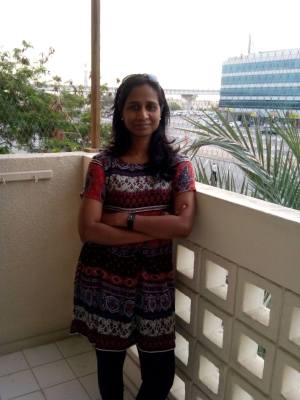
Nazeem’s intense research on finding an alternative medicine for Sainaba, who insisted on never going under the knife, took her to the doorsteps of Pallium India. By then, they had lost faith in every other method from Siddha Vaidya to Allopathy. Nazeem, who believed palliative care is nothing more than serving free morphine, could see the wide range of philanthropy happening under Rajagopal.

Nazeem, who describes her mother as careless and inexpressive compared to the doting mothers in the neighbourhood while she was growing up, becomes highly protective of her in the years that follwed. Sainaba had lived a full-life with her loving husband in Malaysia until she was widowed at the age of 38, with 7 children to look after. But later, she who saved a large chunk of her heart for her only son, had to bear the brunt of his anger. He refused to pay her a visit even in her deathbed.

Sainaba, who preferred to suffer in silence, didn’t even let her children know about the taunting pangs on her stomach. But she had been giving them indications of her impending death. She had gallbladder cancer and nobody came to know about it until it surpassed its fourth stage. Her expatriate children took her to UAE to stay with them but they found her health deteriorating day by day. Nazeem, had to send her back to the comfort of her home in Kerala.

1796088_10203816475118200_1444737296_oSainaba’s long and curly hair bore no traces of her age until her untimely death in 2013. When she stayed with her children in UAE, she asked them to buy her a hair cream. Nazeem who found her sudden interest in haircream amusing, later regrets her words. All cancer patients who undergo chemotherapy have to shave off their hair. But Sainaba, who was in an advanced stage, was not even suggested chemo. Hence, Nazeem’s mother never went bald. Even in her delirious state she had her long beautiful hair haloing her. Through soul-stirring connotations and heartfelt confessions, Nazeem makes ‘My Mother did not Go Bald’ a compelling read.

When mentioned how people are going berserk over her book, Nazeem says, “Many publishing companies had said English books would not get the same reception as Malayalam. I am proud that the sales graph of my book says a different story,” says Nazeem.

Making Music a Lifestyle

  _MG_3596AAHis fingers float from one string to another ensnaring the audience to the intricate notes of Brindabani Sarang (Hindustani raga). Rousing his ‘Mohan Veena’ with a magical touch he plays ‘Hanumatodi’ (a Carnatic raga) with the same ease. Poly Varghese often sends shock waves across the audience by playing Hindustani and Carnatic compositions back and forth.

Interestingly enough, Poly, a Malayali, is the only musician who attempted Carnatic music on a Mohan Veena. Poly, who conducted the very first of his Kerala concerts in Adoor on August 15, is not a familiar face in Kerala and one wonders why.

“For me music is a lifestyle. I don’t want to make it a lucrative business like others. In Kerala I have seen certain musicians using their little knowledge of Hindustani to gain name in movie business. It is not that I have never attempted film music but for me classical music deserves much more respect and exposure than that,” he says. Poly concedes that could be the reason why Keralites find it difficult to accept him. Poly has a few films to his credit such as ‘Kootilekku’ for which he has done composing.

Poly often makes a sight for his onlookers with his wild mane and sen-like disposition. There’s Sufism in every word he pronounces.

“I am from a family deeply rooted in literature and writing. My father was a renowned journalist. So my upbringing has a lot to do with my affinity towards arts. However, I don’t know why I got interested in classical music as there were no musicians in our family,” says Poly. However, Poly’s childhood was rich with the Carnatic vocals lent to him by M L Vasanthakumari,

M S Subbalakshmi and the likes. When children his age chose silly games, eight-year-old Poly gave his ear to the old Murphy radio that opened a wide world of classical music before him.

“That is why I joined Kalamandalam once I completed my tenth. There I was introduced to deeper and meaningful aspects of music. I learnt my first lessons of Carnatic music from Kalamandalam. I was a percussionist there. Later, one of my gurus there prompted me to go to Shantiniketan in Kolkata to learn more about music and Rabindrasangeetham. That was one of the best moves I have made in my life. I grew up reading Mahaswetha devi, Ashapoorna Devi and Tagore. Hence the lure was too strong to ignore,” says Poly. Without any money Poly set about to Kolkata without his family’s consent. At Shantiniketan, he found his calling.

with guruji of mohan veena pt vishwa mohan bhatt

With Pandit Vishwa Mohan Bhatt

One among the five connoisseurs of Mohan Veena, Poly was fortunate to learn the techniques directly from the creator of ‘Mohan Veena’, Pandit Vishwa Mohan Bhatt. Poly, who got to experience Bhatt’s music from a television programme during his childhood years, was easily swayed away by his mesmerising music and facial expressions. Once when Bhatt visited Kolkata, Poly met him in person and admitted how serious he was about learning Mohan Veena. Bhatt was convinced by his earnestness and asked Poly to come to Rajasthan to learn from him. After five years of intense training under the Guru, Poly came back and settled in Chennai.

“It takes three years to make a Mohan Veena from scratch. So if you are not dedicated enough, there is no point in learning it. That is why there are not many takers for this instrument. I don’t mind teaching people the techniques as long as they are not learning it to make money or to enter film industry,” says Poly. Poly who sees great future in his four-year-old daughter, however, feels that only if she comes up with something of her own, she can be considered a musician. “Otherwise just like every other profession she would be choosing the obvious because her father is a musician. I want her to prove her mettle before devoting herself to music,” says Poly.

Poly, who has an enviable repertoire as a musician, has also tried his hand in literature, theatre and what not. He still writes spellbinding poems in Malayalam.

DSC_6919-2“I have had Malayali directors asking whether I can carry Mohan Veena like a harmonium and play it for a scene. If you don’t understand music that’s fine but why disrespect our age-old culture. Money is not everything, it is just a piece of paper for those who doesn’t have any use of it. One should think beyond that,” fumes Poly. Let’s just hope Poly and his inseparable Mohan Veena would be a constant presence in every musical event  to be held in the state henceforth.