A life offered to art (Aug 2013)

  uprecentWhat would a tenth-grade rank-holder, the then talk of the town, do for a living when she grows up? Test her curing skills or break a computer code? When young Parvathi Nayar revealed her dream to be an artist to the school principal all hell broke loose. Between lashes of protests, her parents stood by her and welcomed her decision with both hands. Today, when her name resonates in the realms of Indian art world, Parvathi smiles humbly.

Being a part of Jaya Bachchan’s list of 70 best Indian artists to the Indian Government’s preferred painter for Mumbai International Airport, this woman of substance has been there and done it all.

Having a repertoire as impressive as any other big name in Indian art scenario, this Chennai-based Malayali artist has much to boast off. On her visit to the capital city Parvathi spares some time for the City Express.

“I have always drawn and painted, I suppose a child would always draw and paint but for me it was like finding myself. My mother was a painter, so the drawing materials such a charcoal and brushes were always available. Hence, I started with those at first,” Parvathi reminisces. Rasa- Nine Links
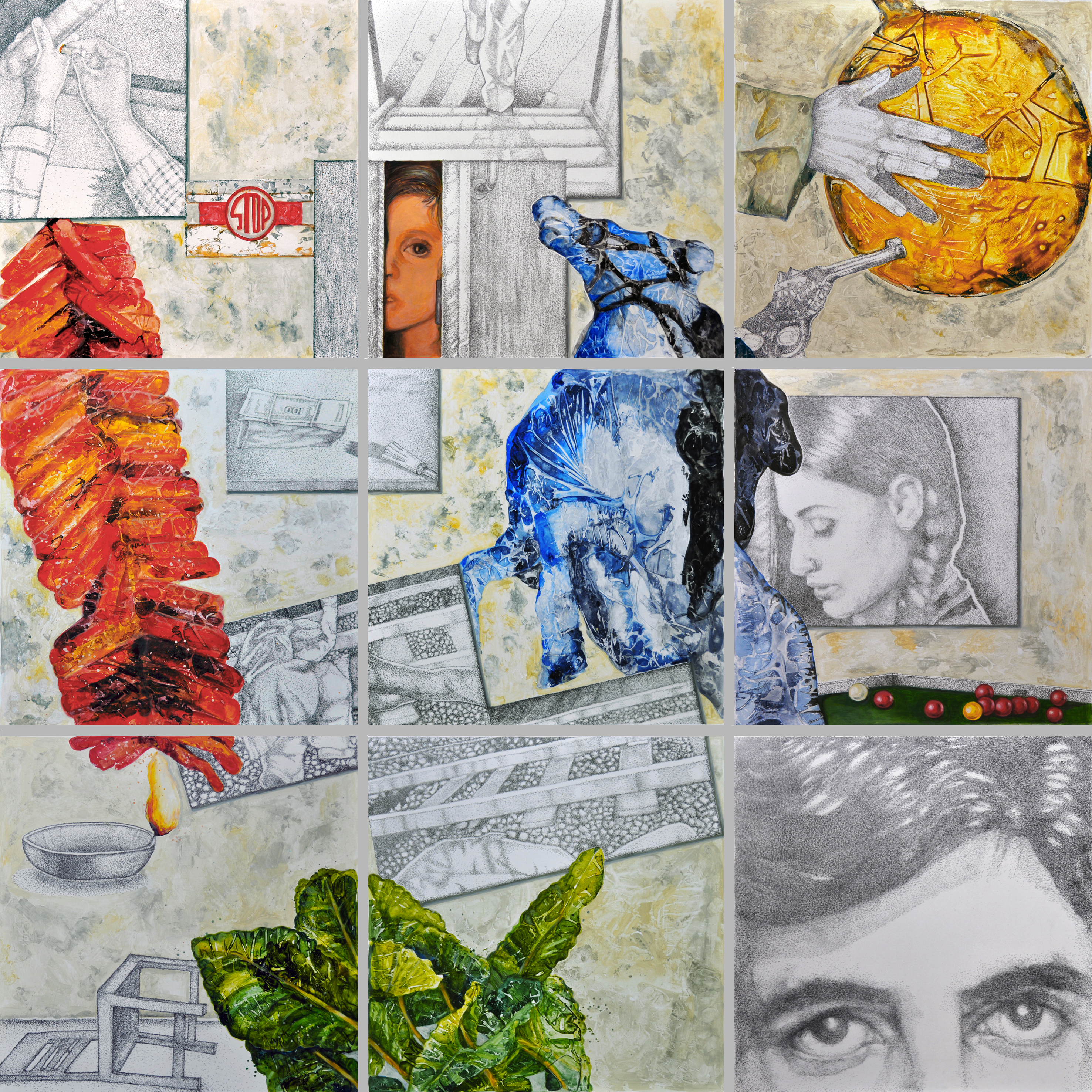
From those vibrant brush strokes that aided her in forming her individual style, Parvathi has come a long way. Today, her love for detailing which was persistently there ever since she commenced her artistic journey, has made her abandon lines and colours to find solace in pencil dots. It is with those pencil dots, she has created magic on humongous canvases that could narrate volumes in a glance.

“When you put a lot of detail together it tells a story.  Like in literature, sometimes it is very descriptive that it delves deep into people’s psychology. But it is not the end in itself. For me, the detailing is a visual hook. It draws you in but then I am hoping you will see something larger beyond that,” Parvathi elucidates.

Parvathi’s works, be it the forensic cinema or the win lose draw series have similar qualities that prod human minds with unanswered questions. With intricate contours of pencil dots she unfastens the myriad facets of world and lets the viewer indulge in its complexities.

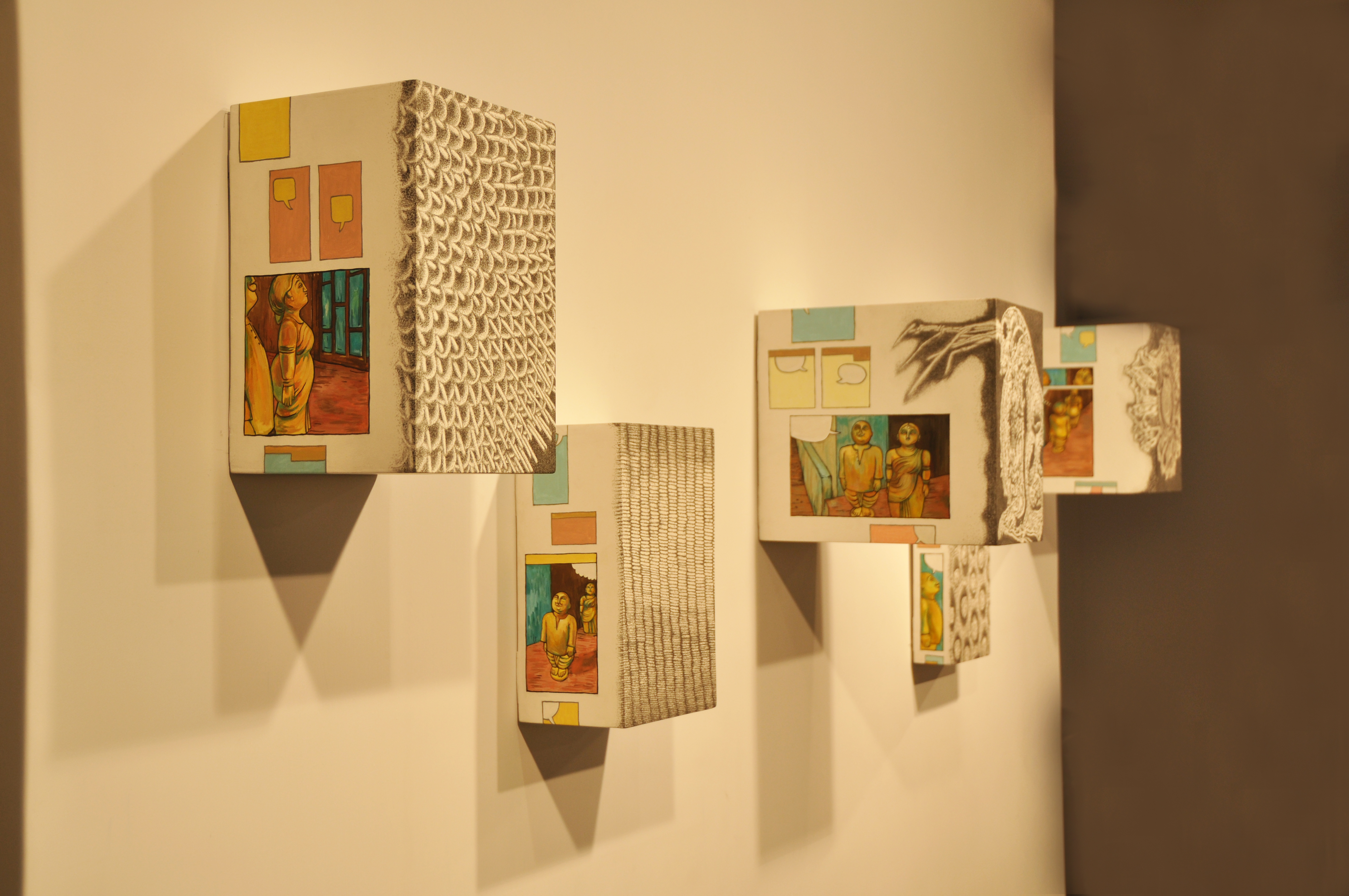
The poignant voids between the black dots are her protagonists. In her forensic cinema series, on wooden panels she freezes Raj Kapoor and Nargis in their Awara avatars and enmeshes the fast moving imagery of cinema with the mating of sperm and egg.

In that mélange of love and life, she captures the essence of forbidden love while beautifully depicting a sperm’s journey to meet with its counterpart.

But within all its unfathomable yet vocal obscurities of her cinema series, she tries to converse with the common man through hilarious English subtitles that accompany regional language films.

vrana2A stern and sober Raj Kapoor pronouncing ‘I am no gentleman, savage” would bring a smile to anybody’s face.

“The English subtitles for Indian films are quite interesting. When you do word-by-word translation, instead of meaning the same thing there is a big chance that whatever the actor wanted to convey becomes hilarious. Like the one or two I have given in the Forensic Cinema and my Tamil cinema series,” says Parvathi.

While the forensic and bones series deal with the body and its intricacies in minute details, location| locality series tries to locate our existence in our own body while interconnecting it with pathways and maps.

After receiving her Masters in Fine Arts from Central St Martins College of Art and Design, London, on a Chevening scholarship from the British government in 2004, Parvathi has gained a renewed confidence that took her to places.

Being the only Indian artist to present an installation of drawings at ArtSingapore, Singapore’s national art fair to having her works collected by institutions such as the Singapore Art Museum, The Sotheby’s Art Institute and Deutsche Bank, Parvathi’s achievements in the art field is immense.then and now 2
She was among the seventy Indian artists including Anjolie Ela Menon, Akbar Padamsee, Badri Narayan and Satish Gujral selected by Jaya Bachchan to celebrate Amitab Bachchan’s 70th birthday by presenting him with 70 paintings. In her painting Rasa,  panelling nine parts of Amitabh’s film Zanjeer which had him in his ‘angry youngman’ persona for the first time, she captures the most memorable moments of Bachchan’s performances in black and white and eases them out with a hint of crimson and jade here and there.

With a lighted fire cracker or sheer simplicity of a shrub, which stands apart from the pencil dot backdrop, Parvathi brings in fresh socio-cultural dimensions to the work. In Parvathi’s works the world achieves more vicinity in its details.

However, the abstract-like quality to it disappears once the work piques you in.

“Say with the forensic work, a lot of people approach it like, oh my god she did it all by herself and it’s so much work, so much detail and then they think it is an abstract.  Once that draws you in, you realise there was something more to it. There’s a narrative, there’s a story, that it is looking at the body, life and the world in a different way,” quips Parvathi.

Parvathi-Nayar-1Parvathi says in order to survive in today’s art world one should constantly negotiate what is decorative, art and craft. And shape oneself accordingly.

When she looks at her love for detail, Parvathi also feels that she is very Indian at heart. “So there is that Indian impulse, even if it is the mehendi on your hand, the sari weaves, the designing quality about all of it is always there,” she says.

About her daughter she says, “I really feel she is rewarding me rather than me rewarding her. It is really enriching as it is fulfilling in both ways for the child as well as me.

Parvathi’s love for her homeland is evident when she says she would love to do a series on Kerala streets sometime. She is waiting to capture the beauty of god’s own country with a camera to create something wonderful with it.


Firm Pedestal for Footwork (Sunday Magazine Feb 2014)

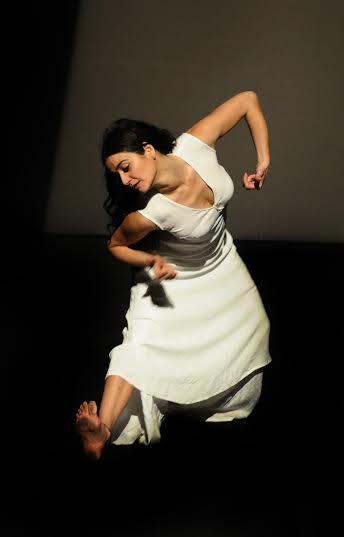
unnamed   Twenty years ago, when Monica de la Fuente first came to India, she did not have any inkling about the country or its ethos. Today, as one of the founders of an Indian cultural centre in Spain, with an impressive repertoire as an Indian classical danseuse, Monica is a name that resonates on the international dance scene.

Her dance school, ‘Kalasangam’ in Spain is one of the first Indian institutes in Spain which is recognised by the government. Monica teaches Bharatanatyam, Kathakali and Flamenco to Indian and Spanish children. “My dance school does not specifically teach one form,” says Monica. “One day I might teach them the basics of Bharatanatyam and on another, the nuances of Flamenco. There are many adopted Indian children in Spain and I have around eight who want to learn about their culture and tradition.” Once she finds them adept in whatever she teaches, she urges them to go to India and learn more.hh

The 39-year-old danseuse chanced upon Bharatanatyam when she saw a performance by Alarmel Valli at the Khajuraho Dance Festival in 1994, while she was on a summer vacation with her boyfriend, later husband Guillermo Rodriguez Martin. A theatre aficionado, Monica got hooked on to Bharatanatyam, where unlike similar dance forms around the world, the expressions are as important as the steps.


“Alarmel directed me to Kalakshethra at Chennai where I learnt the basics of Bharatanatyam from Meena Raman,” says Monica. “I called up my mother and told her that I was joining Kalakshethra and will not be coming back anytime soon.” In the end, she stayed four years. Later, Monica discovered Kathakali in one of her travels around South India. Her decision to learn Kathakali, a much more expression-oriented art form, was impulsive. She not only gained a scholarship from Spain but also from the Indian government to pursue her love for the dance form.

“But there were many who felt that I should stick to Bharatanatyam and learn it thoroughly, but I felt it is necessary to learn Kathakali as it is an art form that gives expressions its due,” says Monica, who came to Thiruvananthapuram recently and joined the Margi Kathakali Centre to expand her knowledge. jk

Meanwhile, Monica’s husband, Guillermo, who has done his Phd from Kerala University, founded an Indian Council for Cultural Relations centre in Valladolid, Spain, Casa de la India in 2003. Since then, Monica is in charge of the performing arts of the centre and has been conducting various festivals. At one such festival, she met Carnatic fusion singer Ravi Prasad, who hails from Kerala, but is settled in Toulouse, France, for the past 30 years. They found a method to incorporate flamenco and Carnatic art-forms and give breathtaking fusion performances.

ss“Ravi Prasad has experience in singing Flamenco music,” says Monica. “I invited him to do a play based on the Ramayana. He provided the music for that. We performed at the Thrissur School of Drama. Later, he would sing Spanish Flamenco music to which I did Indian-style dancing. The performances were more out of impulse than practice. Ravi has an amazing base in music so he can adapt to any style. We have been performing together for the last 10 years.”

A Lensman’s Journal (May 04, 2013)

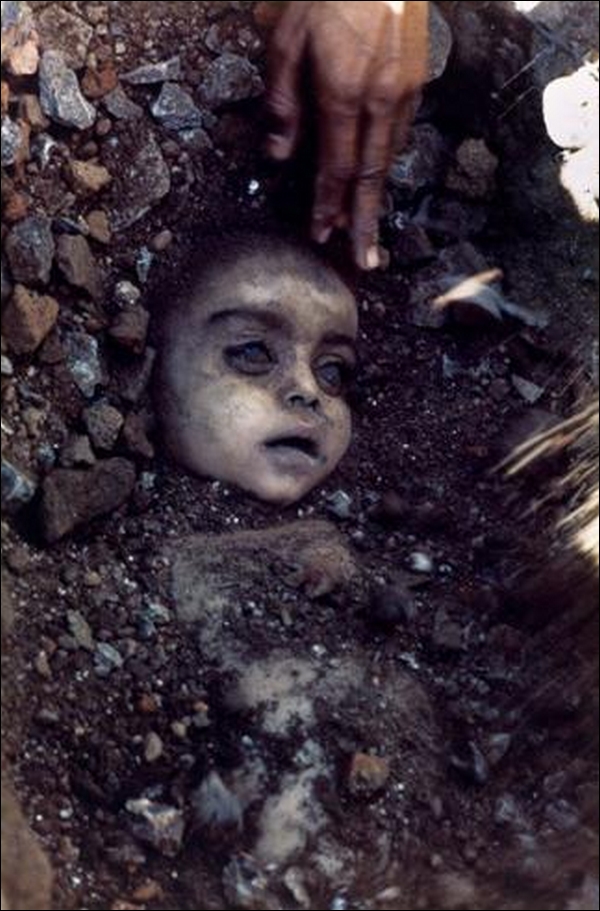
Beneath the sand and gravels shined her porcelain-like skin, innocent blue eyes wide with wonder and half-open mouth concealed an unruly cry, she was all but a child, and one among the 3,787 people died in the Bhopal tragedy. When the picture trails you through the roads of angst and despair Bhopal has endured, one wouldn’t hesitate to agree ‘a picture is worth a thousand words’. When lensman Pablo Bartholomew’s eyes travel through the time and people in a shutter speed, his camera deftly captures these breath-taking signature photographs.3108

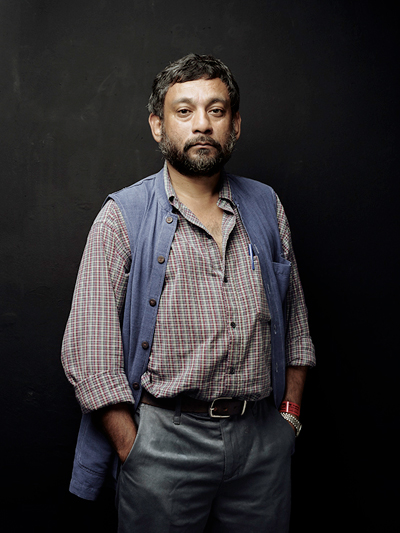
For Pablo, who has won this year’s Padma Shri for his photojournalistic expeditions, his photographs are methods to express the creative streak in him. With a career spanning 40 years, Pablo has nothing but humility as his cohort. Having had Richard Bartholomew as his father, who had practically dominated Indian art-critic world in his era, Pablo did not have to look anywhere else for mentors. Within his multitude of talents Richard hid his photographic skills as well.

“My father was not only an art critic, he was a thinker, poet and also a photographer, so we had photography equipments and darkroom facilities at home. I was introduced to the world of photography when I was 7 or 8 and with my new camera at hand I took photos of everyday subjects. So it was very easy for me to take up photography as my passion,” says Pablo. Pablo’s house was a meeting place for a stream of creative people as both his parents enjoyed inviting their friends over. His mother Rati Batra, was a theatre artiste, hence Pablo had the luxury to meet all genres of artists like directors, actors, writers, and also his fathers artist friends. IMG_20130408_2206235

“It was not only my father who was creative but my mother being a theatre artiste was quite adept in art and literature. I have got the opportunity to closely watch these creative minds at work and learned very early that it is art that would lead me to what I want to become. There was so much creativity around me and I got inspired easily,” says Pablo. He chose people as his subjects at a very young age and wrote poems of their expressions with his camera.

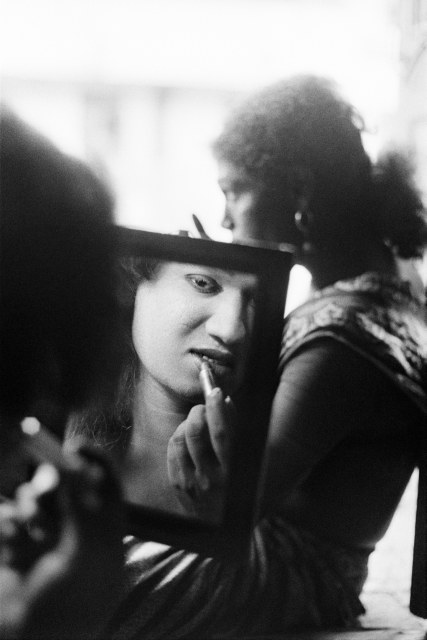
His award-winning photo series ‘Morphine addicts in India’ etches an unknown world masked underneath the polished morale of India and Indians. Myriad portrayals of a woman addicted to morphine, her insufferable agony, her shattered ego, her stooped eyes, her contemplating gestures, come and go in various frames. The helplessness that exudes from her face defines the youth of 70s and their forbidding indulgences.

Pablo says the digital era is not threatening as evolution of technology is inimitable, nonetheless, not all can take a good picture that has all the ingredients of one.

“It is just like writing. Anybody can write today, but is it all writing? With a good computer application one could correct grammar, spelling errors and make a good sentence, but is it actually writing? Likewise a digital camera can take good pictures but the aesthetics of photography is for those who are real photographers,” He says.

Chronicles of a Past Life - BOMBAY 70's & 80'sPablo who had grown up learning the hard way of photography techniques, decided to quit his school at a very young age. “Photography was my vision as I was not keen on education. It became my calling as I chose photography over school. No parents will support your child’s decision to quit school, so even though they were reluctant at first, being liberal, they accepted my decision,” he says.

Pablo received World Press Photo award at the age of 19 for his series Morphine Addicts in India. His photo on Bhopal gas tragedy (1984) won that year’s world press photo of the year award. Pablo who has travelled immensely in India recalls his visiting Kerala as rewarding. Though landscapes are not his forte, Kerala, he says, has gifted him beauty nestled in its breathtaking mountains and valleys.

A photojournalist has to be particular about his role, says Pablo, as it is very easy for him to fall for the victim in a crisis situation. “Is he an activist, a neutral observer or a person who could broadcast this picture and make a difference to the situation? A photographer should make his mind about his role, when he is dealing with sensitive situations,” says Pablo. Pablo received his Padma Shri on Friday, April 5th. “Receiving a Padma award is overwhelming as I count it as a recognition for both my and my father’s works,” says Pablo.


Link

Solitaire!! (Continues)

cryI stood under the stairway patiently. Every footstep made my heart skip a beat. As per her Assistant’s instruction we sat down on one of those plush sofas. The cold lemonade she offered did not cool down the excitement and anxiety I was feeling but it sure did help me to rehearse my lines and check my appearance once again. After an hour of sitting and waiting, I got to see a glimpse of an off white saree’s pallu trailing down the stairs.The clicks of high heels which would make any sane person’s heart flutter like a butterfly followed. She alighted from the staircase making it look like an air plane.  The smile of calm she offered me cordially was  fake or real? I wondered. But she looked like she was at peace with herself.

Soon the questions I have prepared so charily in my mind vanished into thin air, leaving me at a loss. I hardly collected my wits together by the time she asked “shall we start?”. “Yes shall we?” I replied acting enthused. Over the years we have developed a familiarity between each other, however it never went beyond the border of cordiality and touched friendship. There was mutual respect of course. Since I have diverted my field to hardcore journalism, reporting war and sometimes peace after my small stint in the entertainment industry, we rarely met. But then this story is hardcore or there’s nothing more hardcore than this. All I needed was her to tell me the truth about that night. But as far as I knew her she was not going to give me anything. She knew to play the field very well. Even during her early years in the industry she knew how to tackle press.

In that plain but elegant sari she was a vision in white. The crow’s feet that appeared on each side of her eyes painted an attractive but mature picture. Oh she aged beautifully.

“Prameela this is not the time to feel discouraged, be confident, shoot those brilliant questions you prepared at her. If at all the assumed role of Meghna in those happenings were true, you are sitting in front of a criminal not the talented soft spoken lady you always thought she is” I reminded myself.

She showed her discomfort in being recorded. “Pramila I thought it’s a one-on-one chat. The police have specifically asked me to not give any interviews so please do not record. I agreed for this chat only because I need to tell you something”.

→ To be continued